


 Tiếng Việt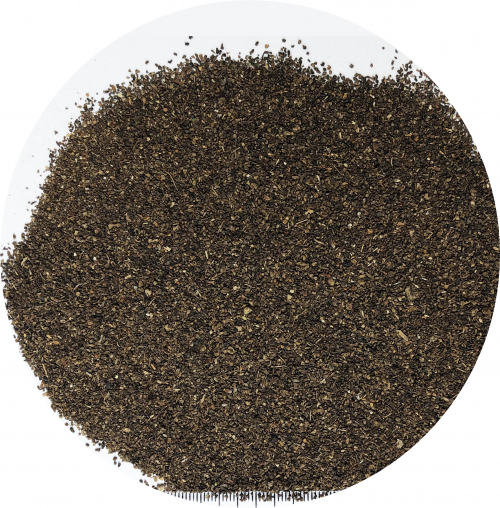
A comprehensive guide to CTC tea covering processing technology, grading systems, export specifications, and industrial applications for global B2B buyers.
1. What is CTC Tea? (Definition)
CTC tea stands for Crush – Tear – Curl, a mechanized processing method used to produce granular black tea particles with high uniformity.
Unlike orthodox tea, which preserves leaf structure, CTC processing breaks down the leaf cellular matrix, accelerating oxidation and enabling:
- Faster infusion kinetics
- Higher extractability
- Consistent batch quality
This makes CTC tea the dominant raw material for tea bag production and mass-market tea consumption globally.
2. Scientific Basis of CTC Processing
From a biochemical perspective, the CTC process enhances enzymatic oxidation by:
- Rupturing cell walls → releasing polyphenol oxidase
- Increasing surface area → faster oxygen interaction
- Promoting uniform oxidation
Key chemical transformations:
- Catechins → Theaflavins (brightness, briskness)
- Catechins → Thearubigins (color, body)
? This results in:
- Dark liquor
- Strong body
- High caffeine release
3. Detailed CTC Processing Workflow
Step 1: Withering
- Moisture reduced from ~75% → 55–60%
- Increases leaf pliability
- Initiates biochemical reactions
Step 2: CTC Machine Processing
Leaves pass through rotating toothed rollers:
- Crushing → phá vỡ cấu trúc lá
- Tearing → tăng diện tích bề mặt
- Curling → tạo dạng hạt
? Đây là bước quyết định chất lượng CTC.
Step 3: Oxidation (Fermentation)
- Duration: 45–120 minutes
- Temperature: 25–30°C
- Humidity: 90–95%
? Oxidation level: ~95–100% (fully oxidized)
Step 4: Drying
- Final moisture: 3–5%
- Stops enzymatic activity
- Stabilizes shelf life
Step 5: Sorting & Grading
Using vibrating sieves to classify particle size.
4. Physical & Chemical Characteristics
Physical
- Particle size: 0.2 – 2.0 mm
- Shape: granular / pellet-like
- Color: black
Chemical
- Moisture: ≤ 5%
- Total polyphenols: 20–30%
- Caffeine: 2.5–4%
- Water extract: ≥ 32%
? These parameters define brew strength and commercial value.
5. CTC Tea Grading System
CTC tea is classified based on particle size and density:
| Grade | Description | Application |
|---|---|---|
| BP | Large particles | Strong brew |
| BOP | Medium particles | Balanced |
| PF | Medium-small | Tea bags |
| PD | Fine particles | Quick infusion |
| Dust | Very fine | Industrial / tea bags |
? Smaller size = faster infusion but lower visual value.
6. Technical Export Specifications (B2B Standard)
Typical export parameters:
- Moisture: ≤ 5%
- Foreign Matter: ≤ 0.5%
- Fiber Content: ≤ 16%
- Water Extract: ≥ 32%
- Ash Content: ≤ 8%
- Acid Insoluble Ash: ≤ 1%
Microbiological:
- Total Plate Count: within limits
- No mold / no pathogens
? Compliant with ISO, HACCP, FDA requirements.
7. CTC vs Orthodox Tea (Technical Comparison)
| Factor | CTC | Orthodox |
|---|---|---|
| Leaf form | Granular | Whole leaf |
| Infusion time | Fast | Slow |
| Flavor | Strong | Complex |
| Use | Tea bags | Premium tea |
| Cost | Lower | Higher |
? CTC = efficiency & scalability
? Orthodox = quality & specialty
8. Industrial Applications of CTC Tea
1. Tea Bag Manufacturing
- Global standard raw material
- Fast extraction
2. Milk Tea & Chai
- High caffeine + strong body
3. RTD (Ready-to-Drink) Tea
- Stable extraction profile
4. Blending Industry
- Ensures consistency
9. Why B2B Buyers Prefer CTC Tea
- High extraction efficiency
- Stable quality across batches
- Cost-effective
- Easy to standardize
- Suitable for automation
10. Conclusion
CTC tea represents a highly engineered product in the tea industry, optimized for efficiency, consistency, and large-scale consumption.
For global importers, it offers a reliable, scalable, and commercially viable solution, especially in tea bag production and mass-market applications.
