

 Tiếng Việt
As the global coffee industry increasingly prioritizes ethical production and environmental stewardship, sustainable coffee sourcing has become a non-negotiable imperative for B2B importers. Vietnam, a powerhouse in Robusta production and a growing force in Arabica, is at the forefront of this transformation. This comprehensive guide delves into the evolving landscape of sustainable coffee sourcing from Vietnam, emphasizing the critical roles of traceability, ethical practices, and the strategic importance of complying with new regulations like the EU Deforestation Regulation (EUDR). It also highlights Nam Son’s unwavering commitment to building a resilient, responsible, and transparent supply chain for international buyers.
1. The Global Imperative for Sustainable Coffee Sourcing
The demand for sustainably produced coffee is no longer a niche market; it is a mainstream expectation driven by conscious consumers, stringent regulatory frameworks, and a collective industry commitment to mitigate climate change and social inequalities. For B2B importers, engaging in sustainable sourcing offers multifaceted benefits:
Risk Mitigation: Reduces exposure to supply chain disruptions, reputational damage, and legal penalties associated with unsustainable practices.
- Enhanced Brand Reputation: Aligns with corporate social responsibility goals, attracting ethically-minded customers and fostering brand loyalty.
- Market Access: Ensures compliance with international import regulations, particularly in high-value markets like the EU and US.
- Improved Quality and Consistency: Sustainable farming often leads to healthier plants, better yields, and more consistent bean quality over time.
- Farmer Livelihoods: Contributes to the economic stability and well-being of coffee farming communities, securing future supply.
- Vietnam’s coffee sector is rapidly adapting to these global demands, with both local initiatives and international partnerships driving the adoption of sustainable practices across its vast coffee-growing regions.
2. Vietnam’s Coffee Market in 2026: A Shift Towards Value and Sustainability
The Vietnamese coffee industry has experienced remarkable growth, with 2025 marking a record-breaking year for exports, generating nearly US$9 billion. This surge was fueled by global supply shortages and rising demand, particularly for Robusta, which is increasingly favored for blending and instant coffee production , .
2.1. Export Performance and Growth Trajectory
In January 2026 alone, Vietnam’s coffee exports reached nearly US$1.09 billion, a significant 39.5% increase compared to the same period in 2025. The country’s total export volume in 2025 reached approximately 1.6 million tons, contributing to its position as the world’s largest Robusta exporter , .
Table 1: Vietnam Coffee Export Performance (2025-2026 Estimates)
|
Metric
|
2025 (Actual)
|
2026 (Projected)
|
Growth Drivers
|
|
Export Revenue
|
~US$8.92 Billion
|
~US$9-10 Billion
|
Global demand, rising prices, shift to value-added products
|
|
Export Volume
|
~1.6 Million Tons
|
~1.8 Million Tons
|
Favorable weather, farmer investment, deep processing
|
|
Processed Coffee Exports
|
~US$1.78 Billion
|
Increasing
|
Investment in technology, instant/roasted coffee, FTAs
|
|
Average Export Price (Jan)
|
US$5,561/ton (2025)
|
US$5,450/ton (2026)
|
Global market dynamics, quality improvements
|
Source: Vietnam Customs, VietnamNet, Tridge , , ,
2.2. The Rise of Deep Processing and Value-Added Products
A significant trend in Vietnam’s coffee sector is the strategic shift from exporting raw beans to focusing on deep processing and value-added products. In 2025, processed coffee exports reached an unprecedented US$1.78 billion, a 50.4% increase from 2024. This growth is attributed to substantial investments in advanced processing technologies and an expanded production of instant, roasted, and specialty coffee products .
This transition is transforming Vietnam’s image from a supplier of low-priced raw materials to a producer of higher-value coffee products. An illustrative example is cascara tea, an herbal infusion made from dried coffee cherry husks, which was once discarded but now commands a value four times higher than raw coffee beans after deep processing . This deep processing approach, coupled with effective utilization of free trade agreements, has enabled Vietnamese processed coffee to gain preferential tariffs and enhanced global competitiveness .
3. Key Pillars of Nam Son’s Sustainable Coffee Sourcing Framework
Nam Son is deeply committed to integrating sustainability across its entire coffee supply chain, focusing on three interconnected dimensions:
3.1. Environmental Stewardship
Our environmental initiatives are designed to protect and regenerate the natural resources vital for coffee cultivation:
- Biodiversity Conservation: We actively promote farming practices that safeguard local ecosystems, prevent deforestation, and encourage the growth of native flora and fauna within coffee landscapes.
- Water Management: Implementing advanced, efficient irrigation techniques and responsible water usage protocols in both cultivation and processing to minimize water footprint.
- Climate Resilience: Supporting coffee farmers in adopting climate-smart agricultural practices, such as shade-grown coffee, intercropping, and improved soil health management, to adapt to changing weather patterns and reduce greenhouse gas emissions .
- Waste Reduction and Circular Economy: Minimizing waste generation during coffee processing and actively promoting the reuse and upcycling of coffee by-products, such as cascara, as part of a circular economy model.
3.2. Social Equity and Farmer Livelihoods
We believe that sustainable coffee begins with thriving farming communities:
- Fair and Equitable Prices: Ensuring that farmers receive fair and transparent prices for their coffee, enabling them to invest in their farms, improve their living standards, and secure a sustainable future.
- Safe Working Conditions: Promoting and enforcing safe and healthy working environments for all farm workers and processing staff, adhering to international labor standards.
- Community Development: Investing in local coffee-growing communities through initiatives focused on education, healthcare, and essential infrastructure projects.
- Empowerment Through Training: Providing comprehensive training programs to enhance farmers’ agricultural knowledge, improve productivity, and develop crucial business management skills, fostering self-reliance and innovation .
3.3. Economic Viability and Long-Term Partnerships
Sustainable sourcing is built on mutually beneficial economic relationships:
- Long-Term Partnerships: Cultivating stable, enduring relationships with coffee farmers and cooperatives, fostering mutual growth, trust, and a shared vision for sustainability.
- Market Access and Value Creation: Connecting smallholder farmers to lucrative international markets, providing them with stable income opportunities and enabling them to capture a greater share of the value chain.
- Efficiency & Innovation: Continuously implementing efficient processing technologies and innovative practices to reduce costs, improve product quality, and ensure competitiveness in the dynamic global market.
4. Certifications & Traceability: Guaranteeing Responsible Sourcing and EUDR Compliance
Nam Son’s commitment to sustainability is rigorously validated through adherence to internationally recognized certifications and the implementation of robust, transparent traceability systems, which are increasingly vital for navigating new regulations like the EUDR.
4.1. International Certifications
Our sourcing practices are aligned with leading global sustainability standards:
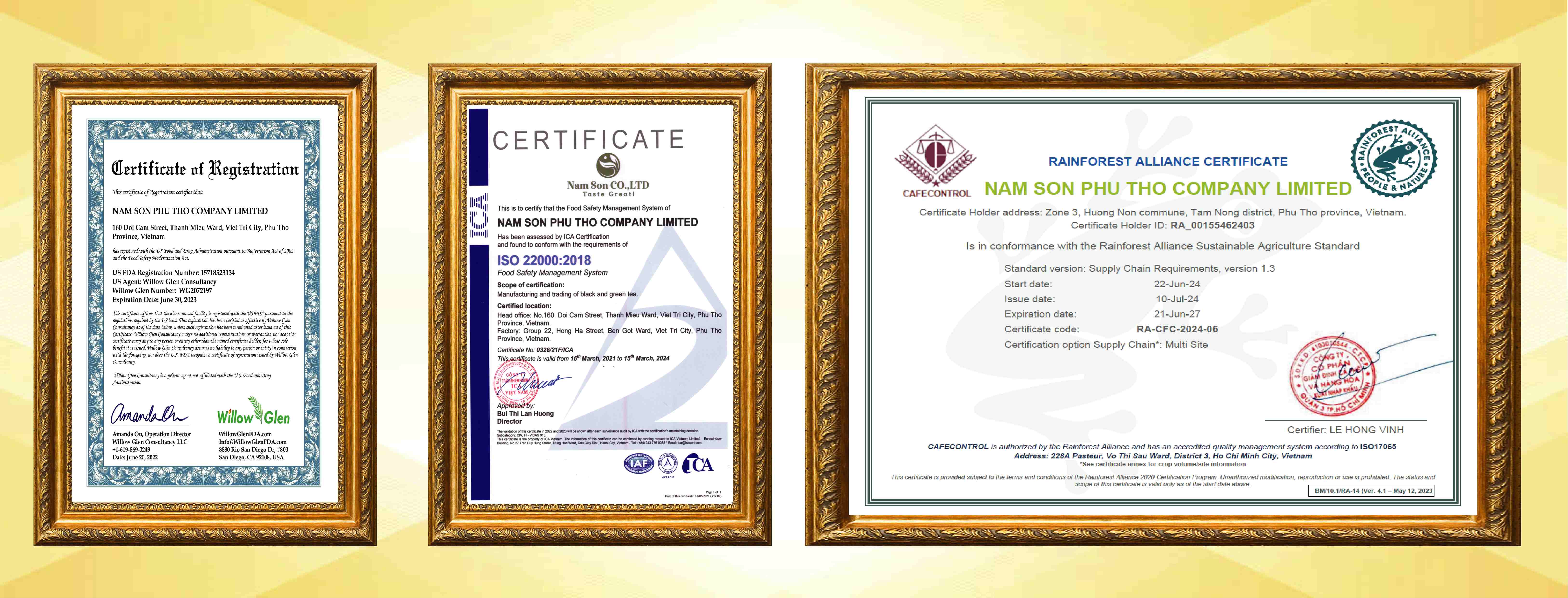
- 4C (Common Code for the Coffee Community): We actively collaborate with 4C-certified farms and cooperatives, ensuring compliance with this comprehensive global standard for sustainable coffee production, which addresses economic, social, and environmental dimensions .
- Rainforest Alliance: Our sourcing includes coffee from Rainforest Alliance certified farms, which adhere to strict criteria for biodiversity conservation, sustainable livelihoods, and environmental protection .
- Other Certifications: Upon request, Nam Son can source coffee compliant with other specific certifications such as Organic (ISO 22000; HACCP; BRC;…) and Fairtrade standards, catering to diverse market demands for certified sustainable products.
4.2. End-to-End Traceability: The EUDR Imperative
The European Union Deforestation Regulation (EUDR), effective from December 30, 2025 (or June 30, 2026, for SMEs), represents a significant shift in global trade. It mandates that coffee imported into the EU must be proven not to have been grown on land deforested after December 30, 2020 , . This regulation places a strong emphasis on verifiable geospatial and land-use data, making robust traceability systems indispensable .
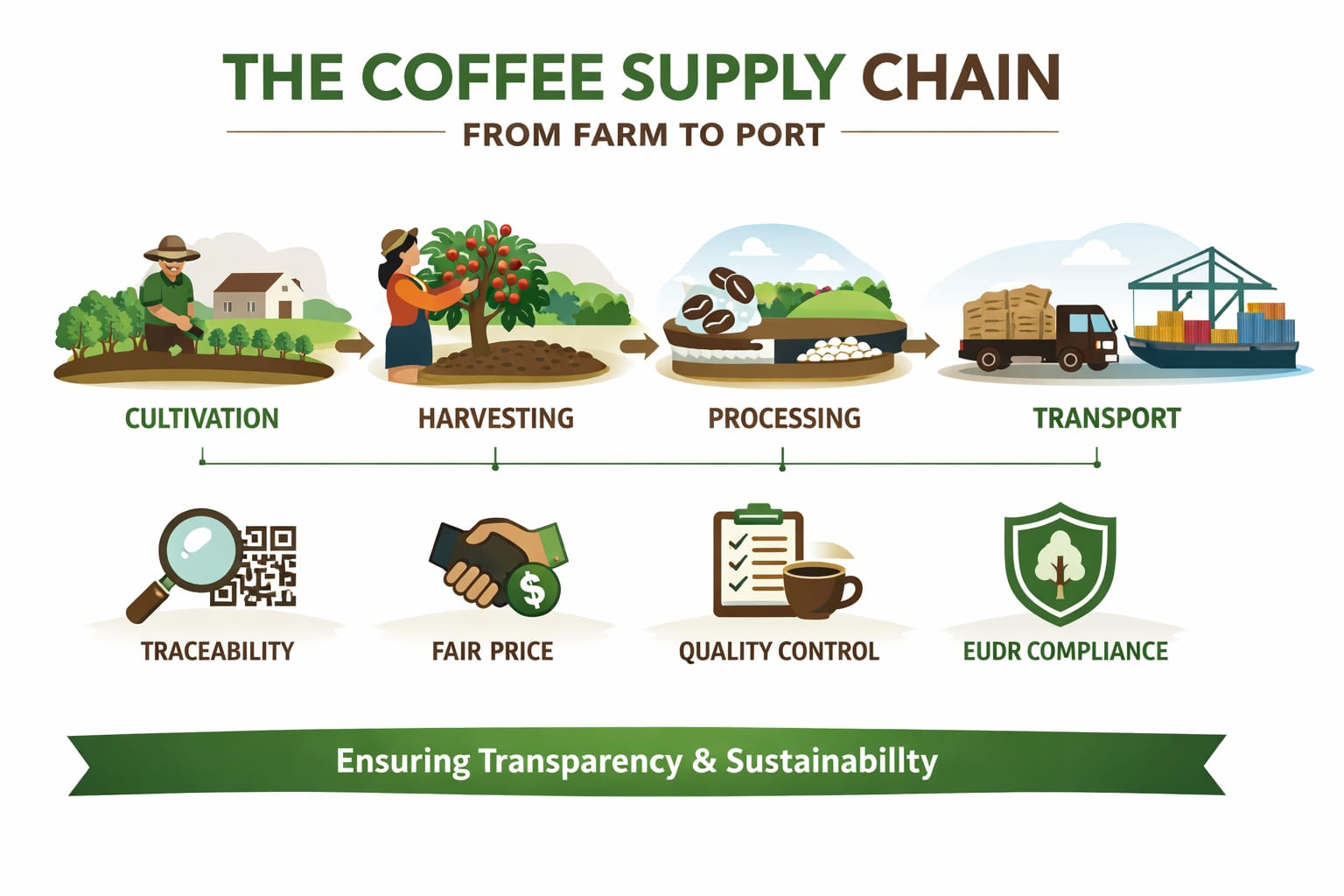
- Farm-to-Port Tracking: Nam Son implements a sophisticated traceability system that meticulously tracks every batch of coffee. This journey begins from its origin farm or cooperative in Vietnam’s Central Highlands, continues through processing, warehousing, and culminates in export. This system ensures unparalleled transparency and accountability at every stage of the supply chain .
- Geolocation Data and Land Legality: We are proactively integrating plot-level geolocation data for individual coffee farms. This is crucial for aligning with EUDR requirements, which demand that coffee be traceable back to its specific origin to verify it is deforestation-free. Addressing land legality – ensuring complete ownership and land-use documentation – is also a key focus, as it is often a“hidden bottleneck” for compliance .
Digital Platforms: Leveraging advanced digital platforms to record and manage comprehensive data related to cultivation practices, processing, and quality control. This ensures real-time access to verifiable and auditable information for our B2B partners, crucial for demonstrating EUDR compliance .
Challenges and Opportunities for Vietnam under EUDR:
Vietnam’s coffee sector faces challenges in meeting EUDR requirements due to its fragmented smallholder-dominated landscape and inconsistent record-keeping practices. A 2025 survey revealed that nearly 60% of smallholders lacked consistent harvest records, and only about 10% maintained plot-level data . However, experts believe Vietnam will remain a significant EU supplier, with a gradual shift towards exporters who invest early in verifiable compliance systems, capturing premium and long-term contracts . The competitive gap is primarily digital and governance-related, which can be closed with traceability platforms and cooperative capacity-building .
5. Benefits for B2B Importers Partnering with Nam Son
Choosing Nam Son as your sustainable coffee sourcing partner offers distinct and strategic advantages in an increasingly regulated and conscious global market:
- Risk Mitigation: Significantly reduce supply chain risks associated with environmental and social non-compliance, including potential fines and market access restrictions under regulations like EUDR.
- Enhanced Brand Reputation: Meet and exceed evolving consumer demand for sustainable products, strengthening your brand’s ethical standing and market appeal.
- Guaranteed Market Access: Ensure seamless compliance with international import regulations, particularly in stringent markets like the EU, securing your access to high-value segments.
- Consistent Quality and Supply: Sustainable practices often lead to improved coffee quality, greater consistency, and a more stable long-term supply, fostering reliability in your procurement.
- Transparent and Auditable Supply Chain: Gain full visibility into the origin and journey of your coffee, backed by verifiable data, fostering trust and enabling robust long-term partnerships.
6. Frequently Asked Questions (FAQs) on Sustainable Coffee Sourcing from Nam Son
Q1: How does Nam Son verify the sustainability claims of its coffee?
A1: We verify sustainability claims through a multi-pronged approach, including rigorous third-party certifications (4C, Rainforest Alliance), internal audit teams, and direct, continuous engagement with our farmer cooperatives. This ensures strict adherence to established sustainability standards and best practices.
Q2: Can Nam Son provide specific sustainability reports and data for sourced coffee?
A2: Yes, upon request, we can provide detailed sustainability reports. These reports include comprehensive information on environmental impact, social programs, farmer income data, and plot-level traceability for specific batches or regions, offering unparalleled transparency to our B2B partners.
Q3: What is Nam Son’s approach to supporting smallholder farmers in Vietnam?
A3: Our approach involves direct engagement with smallholder farmer cooperatives. We provide extensive training, technical assistance, and ensure access to fair market prices. This empowers farmers to adopt sustainable practices, improve their productivity, and significantly enhance their livelihoods, fostering a resilient and equitable supply chain.
Q4: How does Nam Son address deforestation risks in its coffee supply chain, especially concerning EUDR?
A4: Nam Son is proactively working towards full compliance with regulations like the EUDR. We implement robust, plot-level traceability systems that map coffee origins to prevent sourcing from deforested areas. Additionally, we actively promote and support agroforestry practices that integrate trees into coffee farms, enhancing biodiversity and carbon sequestration.
Q5: What types of sustainable coffee products does Nam Son offer?
A5: Nam Son offers a diverse range of sustainable coffee products, including Robusta and Arabica beans, with various processing methods (washed, natural, honey). We can also source coffee with specific certifications (4C, Rainforest Alliance, Organic, Fairtrade) to meet your unique market requirements.
Conclusion: Partnering for a Sustainable Coffee Future
Sustainable coffee sourcing from Vietnam, underpinned by robust traceability, ethical practices, and proactive EUDR compliance, is not merely a trend but a fundamental paradigm shift towards a more responsible and resilient global coffee industry. By partnering with Nam Son, B2B importers can confidently secure a consistent supply of high-quality, sustainably produced Vietnamese coffee. This collaboration not only contributes to a positive impact on the environment and the livelihoods of farmers but also significantly enhances your brand integrity and ensures long-term market access. Embrace the future of coffee with a partner committed to excellence and sustainability.
