


 Tiếng Việt
In daily life, pepper has become very familiar to all of us. It’s a spice that can be found in most Vietnamese dishes. Anyone, whether knowledgeable about medicine or not, has the habit of cooking a bowl of hot porridge, adding a little pepper, onion, and ginger to eat when they have a cold. This shows that some medicinal herbs are very familiar in everyday life. Pepper is one such herb. So, today’s article will introduce more about the characteristics of pepper and some uses that you may not know about.
1. Description of the Pepper plant
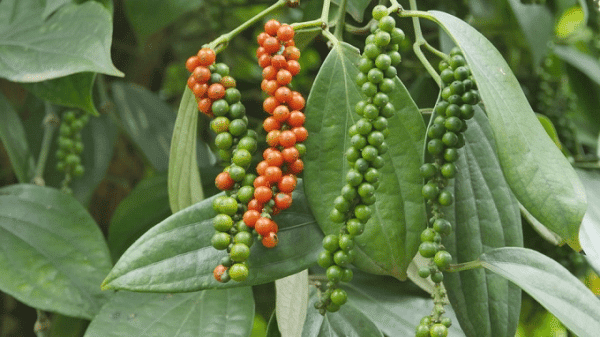
Pepper, scientifically known as Piper nigrum L. , belongs to the Piperaceae family. It is a perennial climbing plant. Its smooth, hairless stem becomes woody and attaches to a host plant with its roots. It has three types of roots: taproot, adventitious roots, and anchoring roots, which help the plant firmly anchor itself to the soil and absorb nutrients.
The pepper plant grows in a spiral pattern and can reach a height of 10 meters. It has two types of branches: one bearing fruit and the other providing nourishment. All branches originate from the leaf axils, and each branch has hook-like roots that attach the plant to a support.
Pepper leaves are simple, alternate leaves. Their shape resembles betel leaves, but they are longer and more tapered. The inflorescence is opposite the leaf. The inflorescence is a spike, 7-12 cm long, consisting of 20-60 flowers arranged in a spiral. Although it lacks a perianth, it is enclosed by numerous bracts.
Peppercorns are sessile, spherical berries. A cluster typically contains 20-30 berries. Initially green, they turn yellow and then red when ripe. Each berry contains only a single seed. Peppercorns are round, hard, aromatic, very spicy, and have a diameter of 4-8 mm. The time from flowering to fruit ripening is approximately 7-10 months.

2. Distribution
Pepper plants originate from India, and India remains the world’s largest producer of pepper. Currently, around 70 countries worldwide cultivate pepper, with leading producers including India, Indonesia, Vietnam, and Brazil.
In Vietnam, pepper was first cultivated in the 17th century in the Ha Tien and Phu Quoc regions. Today, it is grown throughout the country, from North to South. It is especially abundant in the provinces of Binh Phuoc, Ba Ria-Vung Tau, Dak Lak, Gia Lai, Dak Nong, Quang Tri, and Binh Thuan, among others.
In 1990, Vietnam became a leading exporter of pepper in the world.
3. Parts used, harvesting, and processing
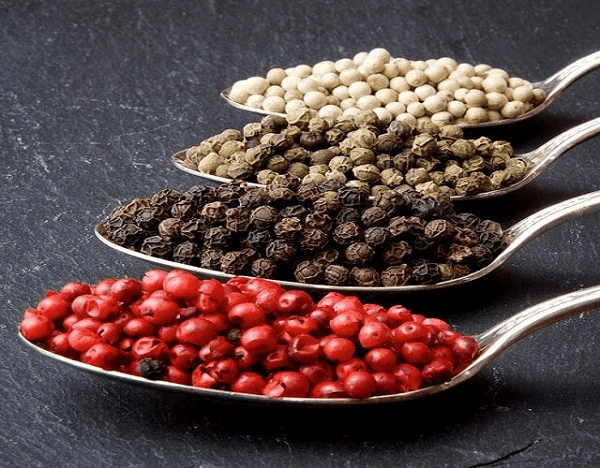
Pepper plants are primarily grown for their fruit and seeds. Pepper is harvested twice a year. The market offers black, white, green, and red pepper depending on the harvest season.
To obtain black pepper, it is harvested when a few red or yellow berries appear on the cluster, meaning when the berries are still green.
To obtain white pepper (or peppercorns), the fruits are harvested when fully ripe, then the outer layer is removed. This type is off-white or gray in color, less wrinkled, and less aromatic (because the outer layer containing essential oils has been lost), but it is spicier (because the fruit is ripe).
Red pepper is a special variety. It must be harvested when the fruit is very mature, ripened, and then processed using a special method to preserve the red color of the peel. This type has the highest export value.
The harvested peppercorns are then sun-dried or lightly dried. Peppercorns can be stored for a long time and are resistant to spoilage. However, they should be stored in a dry place to prevent mold and maintain their quality.
4. Chemical composition and pharmacological effects
4.1. Chemical composition
The outer shell contains 1.2–3.5% essential oil in black pepper and 1.2–2.5% in white pepper. Composed of terpenes (phellandrene, pinene, limonene), it has a fragrant aroma and mild flavor.
The alkaloids in pepper account for 2-5%, primarily piperine (90-95%), which has a pungent taste. Hydrolysis of piperine yields piperidine and piperic acid. Chavicine, an isomer of piperine, also has a pungent taste; hydrolysis yields piperidine and chavicic acid. Small amounts of piperettin, piperylin, and piperolein A and B are also present, which are less pungent.
In addition, black pepper also contains cubelin, which is not spicy, as well as fat and starch.
4.2. Pharmacological effects
In low doses, it stimulates the secretion of gastric and pancreatic juices, improving appetite. However, in large doses, it severely irritates the gastric mucosa, causing congestion, local inflammation, and hematuria.
At high doses of 50 mg/kg body weight, piperine and piperidine are toxic. Piperidine increases blood pressure, paralyzes the respiratory system and some nerves. High doses of piperine are administered intramuscularly or inhaled into rabbits. After a short time, rapid breathing, paralysis of the hind legs, followed by complete coma, convulsions, and internal bleeding are observed.
5. Uses of Pepper
Pepper has a spicy taste and is very hot in nature; it has the following effects:
- Stimulates digestion and improves appetite.
- Warm your stomach.
- Treats vomiting and diarrhea caused by cold.
- Treating colds by inducing sweating, dispelling external cold air and increasing internal heat.
- Black pepper is used to treat diarrhea and dysentery.
- A tincture made from star anise and alum is used to treat rheumatism.
- For toothaches and cavities, rub pepper powder on the base of the tooth to relieve pain and kill bacteria.
- In China, peppercorns are made into a poultice to treat asthma.
- Indians use pepper to treat cholera, boost the body’s strength after fever, and prevent malaria recurrence.
- Indonesians use pepper as an ingredient in several tonics and pain relievers for women after childbirth.
- In Nepal, pepper is combined with other medicinal herbs to treat colds, flu, indigestion, and arthritis.
6. Some medicinal remedies using pepper.
6.1. A remedy for diarrhea and vomiting using peppercorns.
Recipe 1: Crush black peppercorns, grind 50g of old galangal root into powder, and chop 30g of dried tangerine peel. Soak all ingredients in half a liter of white wine for 15-20 days. Drink 15ml three times a day.
Recipe 2: 50g of black pepper, 50g of processed Pinellia ternata. Grind both into a fine powder, mix with ginger water, and form into pills the size of green beans. Take 15-20 pills daily.
6.2. Remedies for toothaches caused by wind or cavities
Black pepper and black sesame seeds, in equal amounts, are ground into a powder. This powder is then mixed with melted beeswax to form a paste, which is then shaped into pellets the size of sesame seeds. One pellet is used at a time to fill a gap between teeth or in a cavity.
7. Note
When consumed in moderation, pepper is good for digestion, but too much can lead to stomach pain and other gastrointestinal reactions. Additionally, excessive pepper consumption can cause acne, hemorrhoids, organ damage, and impaired vision.
Those with digestive disorders or those with yin deficiency and excess heat should not consume it. If adverse reactions occur due to excessive consumption, eat cooked mung beans to detoxify.
Unfortunately, if a large amount of pepper is ingested orally, it can become lodged in the lungs, leading to death, especially in young children.
Pepper is an indispensable spice and a familiar medicinal herb in daily life. However, note that people who tend to have a “hot” constitution should not use too much. Also, limit your pepper intake on very hot days. A daily intake of only 2-4 grams of pepper is recommended. Excessive consumption can lead to bleeding. Thank you for reading!
